Chain Link Mesh Size for Small Dogs: How to Choose
Choose chain link mesh size by comparing the opening with your dog's head, paws, and tendency to squeeze through gaps. For smaller pets, 1-inch mesh limits reach-through more than 2-inch mesh, but secure bottom edges and gates matter just as much.
A sturdy-looking fence can still leave openings that a small dog can push through or get caught in. Focus on the clear opening , rather than the overall appearance of the fence, when comparing options.
Start with your dog's current size and behavior, then assess every possible exit around the yard.
Key Takeaways
- Consider 1-inch mesh for smaller pets because it reduces reach-through compared with standard 2-inch openings.
- Mesh size describes the opening between wires; wire gauge describes wire thickness.
- Measure the actual openings, including stretched sections, gate clearances, and gaps beneath the fence.
- Account for paws, digging, and climbing instead of judging containment by head size alone.
Choose Chain Link Mesh Size Around Your Dog
Your dog's measurements provide a starting point. Behavior helps you decide how conservative the opening needs to be.
Consider the head and squeezing behavior
Look at the width of your dog's head across the bony cheek area, without counting fluffy fur. A ruler held beside a relaxed dog can provide a reference without pressing against its face.
However, a head-width measurement isn't a clearance formula. Dogs can turn their heads, flatten their ears, and approach an opening at an angle. Fur can also make a dog look broader than it is.
Favor openings comfortably smaller than the head, rather than openings that appear almost small enough. If your dog pushes its muzzle into gaps or repeatedly works at barriers, tighter mesh deserves priority.
Don't push your dog's head into a mesh sample. Head entry can create an entrapment hazard even when the body cannot follow.
Include paws and puppy size
A dog may stay inside the yard while still reaching through the fence. Consider whether a paw could extend far enough to contact another animal or become caught during withdrawal.
Observe your dog's relaxed paw beside a ruler. Don't squeeze its toes or insert the paw into an opening.
Smaller mesh reduces reach-through opportunities, but claws can still catch on damaged wire or loose attachments. Also, plan around a puppy's present size . Expected adult size doesn't solve a containment problem during puppyhood.
Compare 1-Inch and 2-Inch Mesh Openings
These two opening sizes provide a useful starting comparison.
| Mesh opening | Practical advantage | Main consideration |
|---|---|---|
| 1 inch | Limits reach-through and can help contain smaller pets | Tighter mesh usually costs more than standard 2-inch fabric |
| 2 inches | Common residential option that generally costs less | Larger openings allow more room for muzzles and paws |
For a small dog that noses into openings, 1-inch mesh is the more conservative starting point.
However, opening size needs to work with the rest of the installation. Small mesh attached to a loose frame can still move, and a tight fence panel doesn't compensate for an oversized gate gap.
When comparing costs, separate the price of the fabric from repairs and installation work. Replacing mesh alone won't correct leaning posts, a sagging gate, or an uneven bottom edge.
A useful quote identifies mesh opening, wire gauge, finish, height, and gate work separately. That makes it easier to compare equivalent designs rather than choosing between two broadly described "chain-link fences."
Measure the Mesh Between Parallel Wires
Chain-link fabric forms diamonds, but the long corner-to-corner dimension isn't the mesh size. Measure the clear distance between two opposite, parallel wires, perpendicular to those wires.
Because the diamond is tilted, that measurement won't usually run straight across the fence horizontally.
- Choose an undamaged opening in a straight section of fence.
- Place a ruler across the opening at a right angle to one wire side.
- Measure between the inside surfaces of the opposite wires, excluding the wires themselves.
- Repeat in several places, including near the bottom and beside gates.
For reference, 1 inch equals 25.4 millimeters, while 2 inches equals 50.8 millimeters. Use a ruler with clear markings rather than estimating against a photograph.
Measure stretched or distorted openings separately. Their actual clearance matters for your dog even when the original fabric had a smaller nominal mesh size.
A fence's labeled mesh size doesn't describe a stretched diamond, a loose bottom corner, or the space beside a gate.
Keep Mesh Opening and Wire Gauge Separate
Two fences can have the same opening size but different wire thicknesses. They can also use similar wire with different openings.
Mesh size controls the space
Mesh size describes the space within the woven fabric. Smaller openings reduce the room available for a dog to push a muzzle or paw through.
Ordering heavier wire doesn't automatically reduce those openings. A fence with thick wire and 2-inch mesh still has a substantially larger opening than one with 1-inch mesh.
Likewise, a black coating changes the appearance and adds protection to the wire. Color alone doesn't tell you the mesh opening or the strength of the underlying wire.
Gauge affects resistance to bending
Wire gauge describes thickness. With common chain-link gauge designations, a lower number generally means thicker wire. For example, 9-gauge wire is thicker than 11-gauge wire.
Our guide to chain-link gauge and mesh size explains how these specifications work together.
Thicker wire can better resist bending, but posts, rails, ties, and tensioning also affect fence stability. For a dog that pushes against the fabric, evaluate the whole assembly rather than buying on gauge alone.
Close Escape Routes Beneath Fences and Gates
Once you've selected the mesh, give the edges equal attention. Small dogs often find openings where the fabric ends or the ground changes level.
Secure the bottom without blocking drainage
Walk the fence line and look for daylight underneath. Pay attention to depressions, corners, and places where runoff carries soil away.
Gently lift the lower edge by hand. Fabric that rises easily may create a larger opening when a dog noses underneath. A properly fitted tension wire or bottom rail can help restrain movement, depending on the fence design.
However, supporting the fabric doesn't fill an existing ground gap or prevent digging by itself. Digging dogs may need a professionally installed buried extension or ground apron with protected edges.
In Southwest Florida, preserve drainage routes when addressing low spots. Solid barriers that obstruct runoff can create a separate yard problem.
Measure gates in their closed position
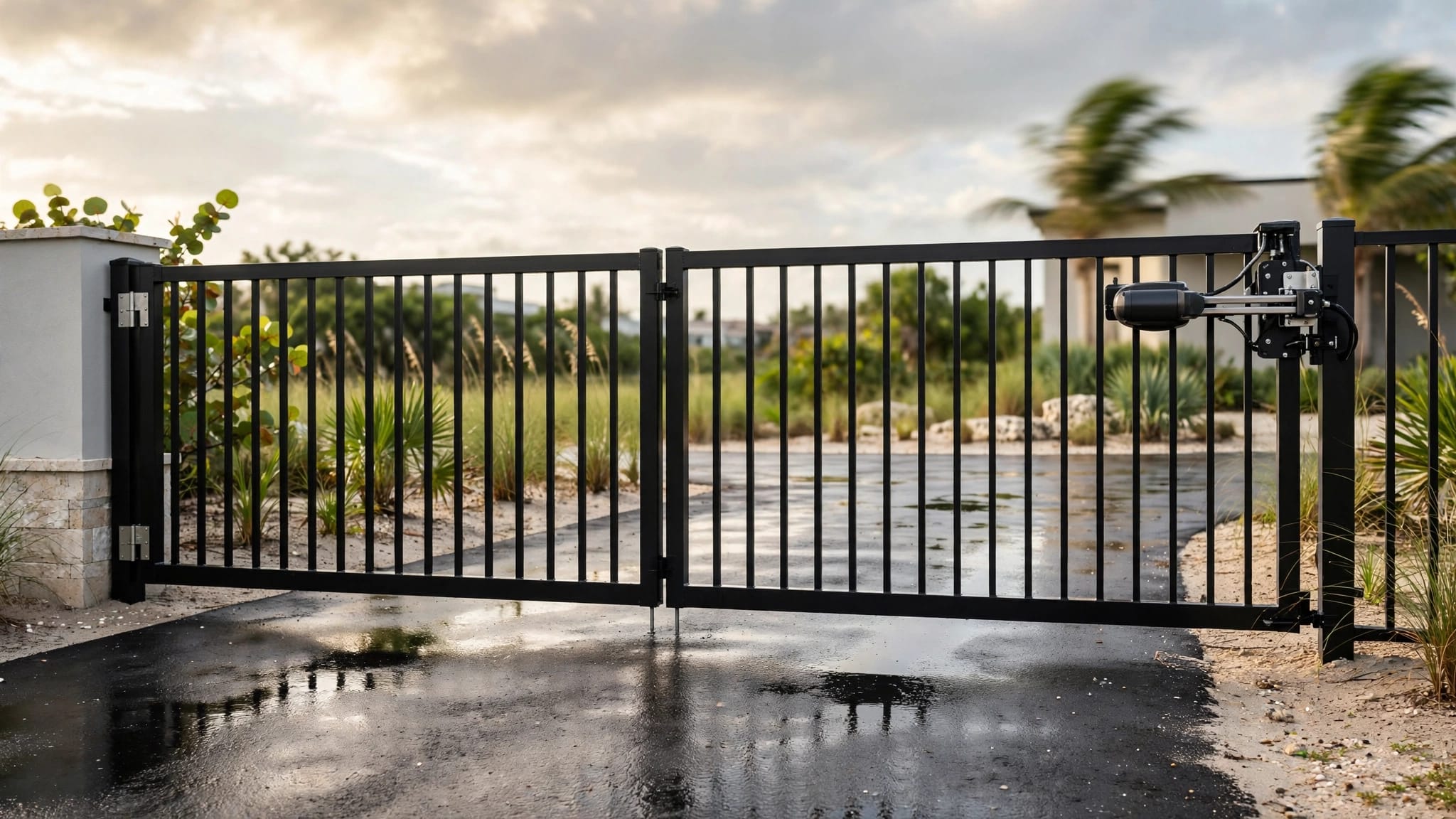
Inspect the hinge side, latch side, and bottom of each gate. Double gates also have a center opening that deserves attention.
Measure the largest clear gap, including any space created when the gate moves within its latch. Then look for sagging, loose hinges, or posts that shift under light pressure.
A gate needs enough clearance to operate without leaving an escape route. Where those needs conflict, the layout or hardware may need adjustment.
Avoid loose wire patches around moving parts. They can snag paws, interfere with closing, or leave sharp ends within reach.
Address Climbing and Material Condition
Smaller openings address passage through the fabric. They don't resolve a dog that climbs over it.
Chain link provides footholds, so a dog with a climbing habit may need a different fence design. Our guide to fence options for climbing dogs covers that separate containment concern. Keep furniture and other launch points away from the fence, too.
If you're comparing materials, aluminum puppy pickets for small dogs offer another approach to narrow openings. Picket spacing needs its own assessment because vertical gaps behave differently from woven diamonds.
For an existing chain-link fence, inspect corrosion, broken ties, bent fabric, and exposed wire ends. Salt exposure can accelerate corrosion, while damaged coatings can leave metal vulnerable.
Also, walk the perimeter after heavy rain or storm debris reaches the fence. Soil loss and bent sections can create openings that weren't present when the fence was installed.
Frequently Asked Questions
Can smaller mesh go over an existing fence?
A securely attached smaller-mesh overlay can sometimes work on a sound fence. However, loose layers can create pockets that catch paws or claws.
The attachment needs smooth, protected edges and secure support, including around gates. If the original fence sags or has damaged posts, repair those problems first. Household netting and loosely tied wire aren't durable substitutes for a properly fitted barrier.
Do privacy slats make large openings safe for puppies?
Privacy slats aren't a reliable substitute for appropriately sized containment mesh. The remaining spaces depend on the slat design and fit, including gaps near the ends.
Slats also add wind load to the fence. Choose the mesh opening for the dog first, then assess privacy as a separate design choice.
Does a dog fence also qualify as a pool barrier?
Dog containment and pool safety involve different requirements. A mesh opening chosen for a small dog doesn't establish that the fence meets pool-barrier rules.
Where the same fence surrounds a pool, its height, openings, gates, and placement must satisfy the applicable pool-barrier requirements as a complete installation. Pet containment needs to fit within that design.
Choose the Opening and Secure the Whole Boundary
For small dogs, tighter mesh can reduce reach-through and make squeezing through the fabric harder. The strongest decision combines a suitable opening with secure edges , sound fabric, and gates that close without escape gaps.
At Supreme Fence of SWFL, we offer chain-link installation and fence repair. Request a free quote for a layout that addresses your dog's size, behavior, and yard conditions together.
The right mesh belongs in a fence that keeps the entire boundary secure, including the places where the mesh stops.