Bradenton Fence Permit Guide for 2026 Homeowners
A fence can improve privacy in one weekend, but a misplaced post can create a permitting problem that lasts much longer. Before ordering materials, check whether your property falls inside the City of Bradenton or unincorporated Manatee County, then confirm the current Bradenton fence permit requirements for your address.
Height, location, materials, corner-lot visibility, easements, and HOA rules can all affect approval. The safest approach is to confirm the rules before installation, prepare a clear site plan, and let the permitting office settle questions that online summaries cannot answer.
First, identify your permitting jurisdiction
The word Bradenton covers more than one permitting path. A property inside the incorporated City of Bradenton generally goes through the City of Bradenton Building and Permitting or Planning and Community Development offices.
A property outside city limits may fall under Manatee County instead. This includes unincorporated areas such as East Bradenton, Lakewood Ranch, Braden River, and Palma Sola. A Bradenton mailing address does not automatically mean the city issues your permit.
Jurisdiction affects the forms, plan requirements, fees, inspections, and contact information. Before filling out an application, check your tax record, deed, utility bill, or municipal boundary map. You can also ask the permitting office to confirm the correct authority.
For City of Bradenton properties, the current contact information published for permitting includes:
- Phone: 941-932-9414
- Email: permitting@bradentonfl.gov
- Office: 101 Old Main Street, Bradenton, FL 34205
- Listed hours: Monday through Thursday, 7:30 a.m. to 4:30 p.m., and Friday, 7:30 a.m. to 3:30 p.m.
Manatee County Permitting lists 941-748-4501, extension 3800 , and permitting@mymanatee.org . Confirm office hours before visiting because schedules and submission procedures can change.
A fence contractor who works across Southwest Florida may know local practices, but the authority for your address controls the approval.
What a Bradenton fence permit may require
Current Bradenton information points to two related requirements: zoning approval and building permits. They are not always the same thing.
The City of Bradenton zoning code requires a zoning permit before constructing or altering accessory structures, including fences. City forms also state that a Permit Application is required for construction, including fence installation. A Fence Affidavit must accompany the application for fence permits, and the affidavit must be recorded before submission.
At the same time, current 2026 permit guidance commonly identifies these practical thresholds:
- A fence over 6 feet high generally requires a building permit.
- A backyard fence 6 feet high or under typically does not require a building permit, although zoning rules still apply.
- A front-yard fence 4 feet high or under typically does not require a building permit, but it must still meet zoning requirements.
These summaries should not replace confirmation from the City of Bradenton or Manatee County. The city forms and zoning materials can apply a broader permit process than a simple height chart suggests. Ask whether your project needs a zoning permit, building permit, recorded affidavit, or more than one approval.
Florida law changes may also affect some smaller residential projects during 2026. However, the state-level discussion does not remove the need to check local zoning, visibility, easement, and HOA rules. Bradenton's city-specific materials continue to identify fence applications and affidavits.
Bradenton fence permit height limits
A compliant height depends on where the fence sits on the lot. In the City of Bradenton, current zoning information lists these general limits:
| Fence location | General maximum |
|---|---|
| Visibility triangle | 24 inches |
| Within 25 feet of a street right-of-way | 48 inches |
| Front yard | 48 inches |
| Side or rear yard | 72 inches |
The most restrictive applicable standard controls. For example, a six-foot fence may fit in a side yard but fail if part of that fence enters the front-yard area or a visibility triangle.
A street right-of-way is not always the same as the edge of pavement. The public area may include a grass strip, sidewalk, drainage swale, or additional land beyond the road. Your site plan should show the fence in relation to the right-of-way, property line, driveway, and nearby intersections.
Corner lots need extra attention. Current Bradenton code materials describe special rules for secondary front yards. A fence may reach 72 inches in some situations, but it cannot extend into a visibility triangle or the primary front yard. Primary front-yard fencing may also need to use open picket or rail construction with at least 75 percent transparency.
The takeaway is simple: measure the fence location before choosing its height. A design that works on a typical interior lot may need changes on a corner property.
Documents to prepare before applying
A complete application reduces back-and-forth with the permitting office. Gather the following before submitting your Bradenton fence permit paperwork:
- Complete the permit application with the property address, owner information, contractor details, and project description.
- Prepare a site plan that shows the house, driveway, fence line, gates, property lines, street, and right-of-way.
- List the fence height, material, post spacing if requested, and gate locations.
- Include a property survey or plat when the fence will sit near a boundary, easement, drainage area, or corner.
- Record the City of Bradenton Fence Affidavit before submitting it when the city requires that document.
- Obtain HOA approval if your neighborhood has architectural or fencing rules.
Manatee County's current permit information lists building plans and a site plan or survey as always required for fence permits. The county may also conditionally require a Notice to Building Official or a Private Provider Plan Compliance Affidavit.
A survey becomes especially useful when property corners are hard to locate. Do not assume an old chain-link line marks the legal boundary. Fences installed across easements or onto a neighbor's land can create removal costs even when the permit itself was approved.
Materials and design rules to check
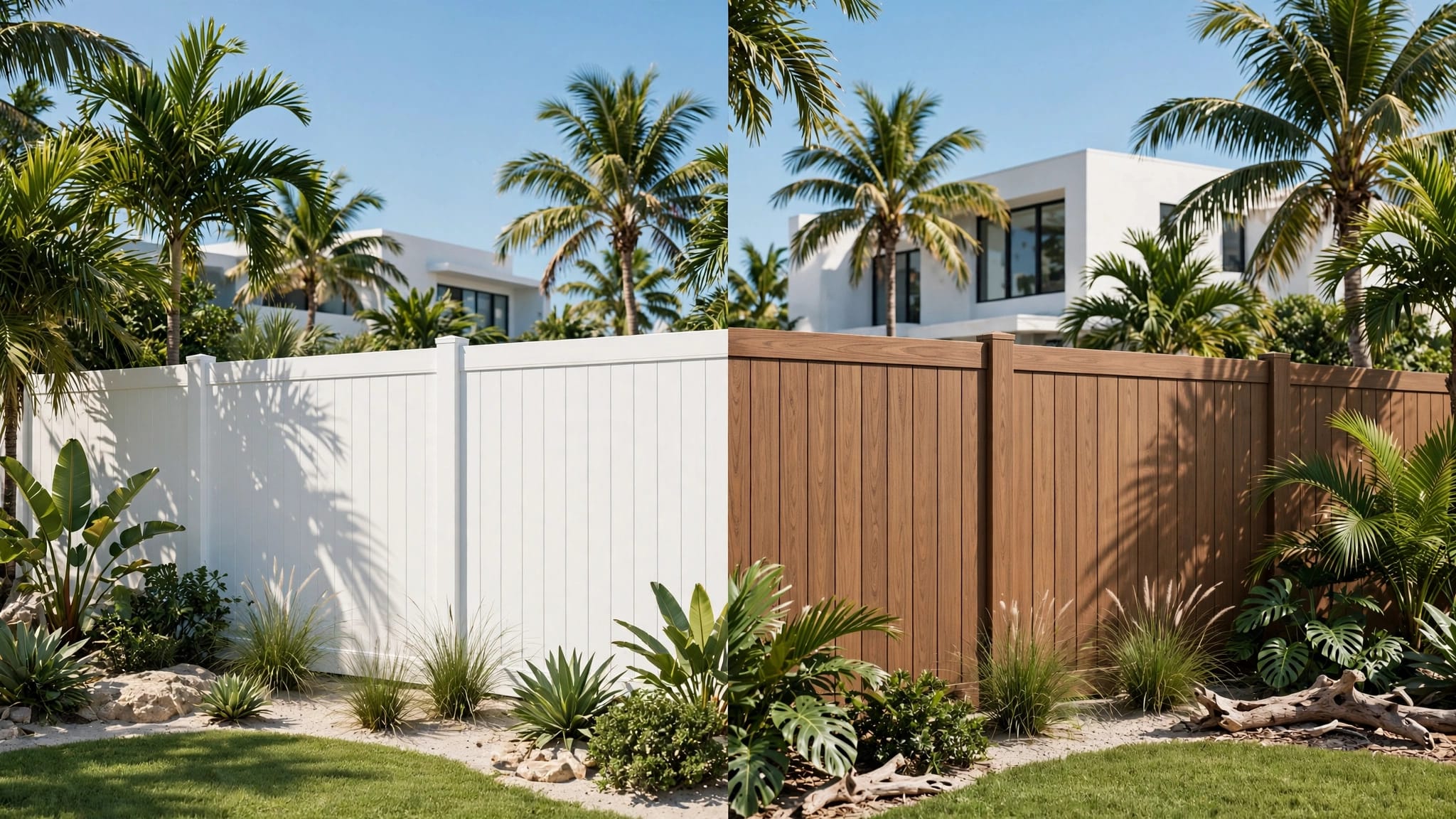
Bradenton homeowners often choose vinyl, wood, aluminum, metal, or chain-link fencing. Each material can work well, but local rules may limit the design in certain locations.
City zoning information says fence materials should be generally compatible with surrounding properties. Barbed wire, cloth, nylon, glass, PVC pipe, corrugated materials, spikes, and similar materials may require City Council approval. Electric fencing also requires special approval under the cited zoning summary.
That matters when a homeowner wants extra security. A tall ornamental metal fence with pointed finials, for example, may receive more scrutiny than a standard open picket design. A privacy fence may be suitable in a side or rear yard but fail front-yard transparency rules.
Material also affects storm performance and maintenance. Vinyl does not rot, but wind can place significant force on posts and rails. Wood allows flexible styles but needs protection from moisture and termites. Aluminum resists corrosion and works well for open views, while chain link offers a practical boundary at a lower material cost.
Your application should describe the actual product and height. Avoid submitting a vague "fence replacement" description when the new fence will use a different material, location, or design.
The 2026 application process
The City of Bradenton began using Accela for permit processing on October 29, 2024. Permits started in the older GoPost system continue there until completion. That means your submission method may depend on when the record began.
A typical process looks like this:
- Confirm whether the city or county has jurisdiction.
- Ask which approvals apply to your fence.
- Prepare the site plan, survey, material details, and affidavit.
- Submit the application through the current permitting system.
- Pay the applicable fees and respond to review comments.
- Wait for approval before ordering installation around a firm construction date.
- Schedule required inspections after construction.
Current guidance estimates roughly two weeks for typical Bradenton fence or gate permit approval, but timing varies with completeness, review volume, surveys, variances, and revisions.
The city's posted fee schedule includes a $25 fee example for a commercial fence or wall. It also lists $300 for a commercial concrete or block wall. Residential fence fees and other charges may differ, so request the current total before submitting.
If an inspection is required, keep the permit number and inspection code available. The city provides inspection scheduling instructions through its permitting contacts. Zoning inspections may use a separate scheduling process, including the planning department email.
HOA, easements, utilities, and property lines
A permit does not override private restrictions. Your HOA may control fence height, color, material, setbacks, and approval timing. Some communities require an architectural application even when the city or county does not require a building permit.
Easements create another common problem. Utility, drainage, access, and stormwater easements may cross a backyard or side yard. A fence may be allowed in some easements only with conditions, while other easements must remain clear.
Before digging, contact 811 to request utility marking. The marks show underground utility locations, but they do not prove your property corners. Use a survey or licensed surveyor when the boundary is uncertain.
Driveway corners and intersections require care as well. A fence that blocks a driver's view can violate visibility rules even if it stays inside the property line. Gates should open onto your property, not across a sidewalk or road area.
When a contractor can help
A local fence contractor can measure the property, identify design concerns, prepare project details, and coordinate installation after approval. Ask whether the contractor handles permit paperwork or expects the homeowner to apply.
Before signing, confirm that the contractor is properly licensed and insured for the work, provides a written scope, and understands the difference between City of Bradenton and Manatee County requirements. The estimate should identify the material, height, gate style, removal work, permit responsibility, and any survey or recording costs.
A professional installation also helps with post depth, alignment, drainage, gate clearance, and storm exposure. For homeowners comparing options, Southwest Florida fence installation services can provide a starting point for discussing materials and project needs.
Do not schedule crews to set posts until required approvals are complete. If the city or county later requires a change, removing new concrete and panels can cost far more than confirming the design first.
Final thoughts
A successful Bradenton fence permit project starts with the correct jurisdiction and a clear site plan. Height limits, corner-lot visibility, front-yard transparency, easements, HOA rules, and material restrictions can affect the plan before construction begins.
For 2026, treat online permit thresholds as general guidance, not a final approval. Confirm the requirements with the City of Bradenton or Manatee County, record the Fence Affidavit when required, and wait for approval before installation.
A few careful measurements and a complete application can keep your fence project on schedule and prevent an expensive surprise after the first post goes in.