Manatee County Fence Permit Guide for 2026
A fence project can hit a delay before installation starts if you mistake a county property for a city property. If you need a Manatee County fence permit , the first step is confirming that your home sits in unincorporated Manatee County and checking whether your fence qualifies for an exemption.
The county separates building permits from zoning compliance. A fence might not need a building permit, yet still violate height limits, easements, visibility rules, or deed restrictions. Use this guide to plan your project, then confirm the current requirements with Manatee County before construction.
Important: This article provides general informational guidance. It isn't legal, surveying, or permitting advice. Manatee County requirements can change, and your parcel may have special conditions.
Does Your Property Fall Under Unincorporated Manatee County?
Your mailing address doesn't always identify the agency that controls your fence project. A property with a Bradenton, Parrish, or Lakewood Ranch address may sit outside the named municipality and fall under Manatee County instead.
Unincorporated areas can include parts of Parrish, Lakewood Ranch, Ellenton, Myakka City, East Bradenton, Braden River, and Palma Sola . However, community boundaries and local jurisdictions can overlap. Lakewood Ranch properties may also fall under Sarasota County or another authority, depending on the parcel.
If your home is inside the City of Bradenton, City of Palmetto, or another municipality, that city's rules may apply. Municipal requirements aren't countywide rules, so don't use a city fence guide for a county property without checking the jurisdiction first.
Look at your property records, tax information, or county mapping tools. You can also ask Manatee County Development Services to confirm the responsible permitting office before ordering materials.
Homeowners in Parrish can review this Parrish fence permit guide for a community-specific look at county permitting questions.
Do You Need a Manatee County Fence Permit?
For 2026 planning, Manatee County guidance generally exempts certain non-structural residential fences from a building permit. The exemption applies when the fence is on a one- or two-family lot and the property isn't in the Regulatory Floodplain.
The county guidance identifies wood, chain-link, and vinyl fences as common examples of non-structural residential fencing. A masonry fence, masonry wall, or masonry column requires a building permit.
Metal and aluminum fences may need individual review, especially if the design includes masonry columns, retaining features, structural elements, or unusual construction. Ask the county how it classifies your planned fence instead of assuming that every residential fence receives the same treatment.
| Project condition | General 2026 building permit guidance | Other review still needed |
|---|---|---|
| Non-structural wood, chain-link, or vinyl fence on a one- or two-family lot outside the Regulatory Floodplain | Generally exempt from a building permit | Zoning, height, easement, plat, and HOA rules |
| Masonry fence, wall, or column | Building permit required | Site placement, zoning, structural details, and other applicable reviews |
| Fence on a property in the Regulatory Floodplain | Confirm with the county before work | Floodplain, zoning, drainage, and site-specific requirements |
| Fence in an overlay district, easement, or unusual lot condition | Confirm with the county before work | Overlay, visibility, access, and property restrictions |
A permit exemption only addresses the building permit. It doesn't authorize construction across a property line or inside a utility easement. It also doesn't override a planned development's standards, a recorded plat, or a homeowners association's approval process.
The first Manatee County fence permit question should therefore be, "Is my project exempt?" The next should be, "Where can the fence legally go, and how high can it be?"
Manatee County Fence Permit Height and Placement Rules
The county's zoning and land development rules control fence height and location, even when no building permit is required.
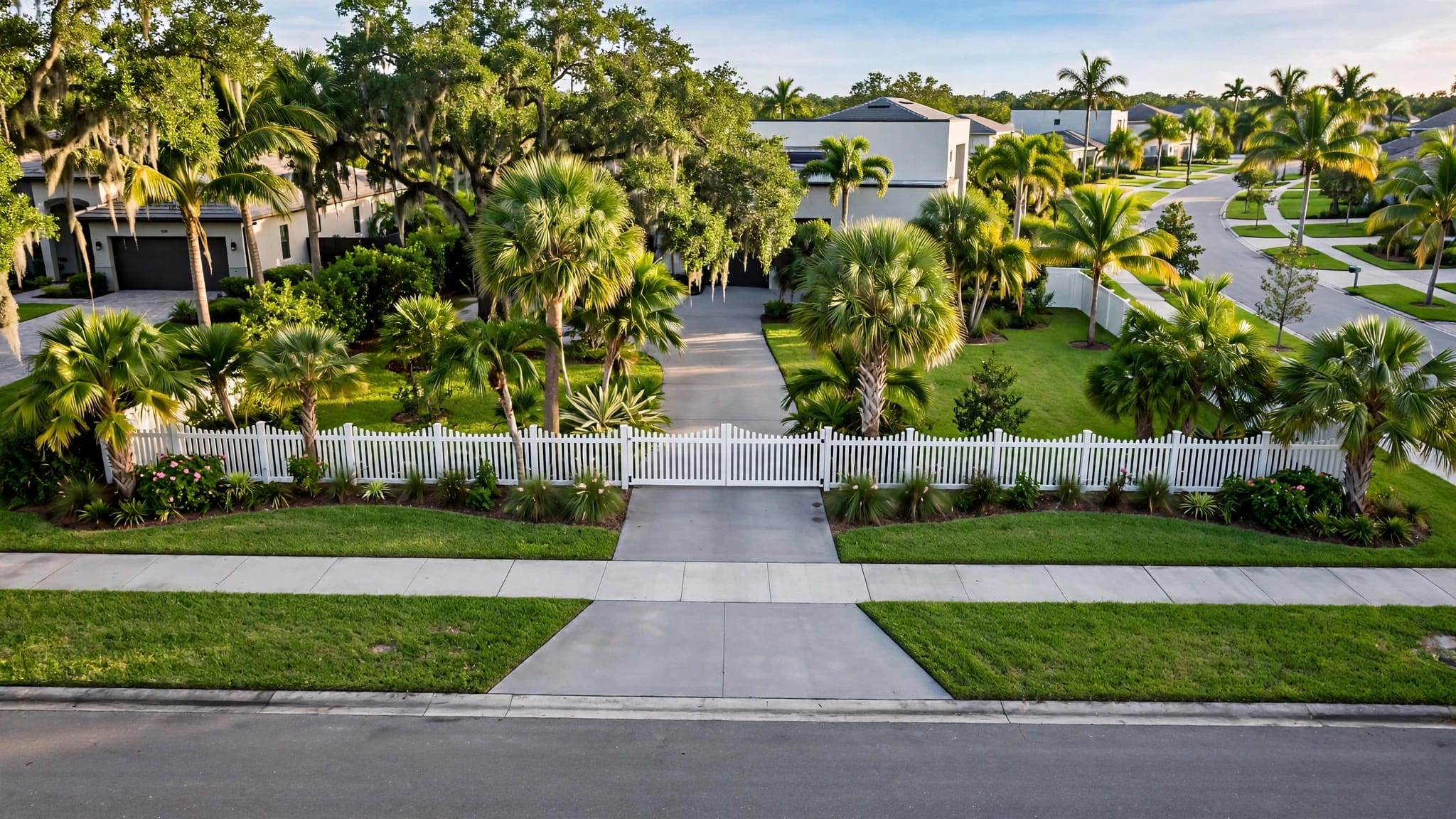
Front-yard fences are generally limited to 4 feet
Fences, berms, or combinations of berms and fences within a required front yard are generally limited to 4 feet in height. This rule often surprises homeowners who want a tall privacy fence along the street.
Side and rear yards have a higher general limit. Fences within required yards other than front yards are generally limited to 8 feet .
The exact location of the front yard can depend on the lot, street frontage, building orientation, zoning district, and recorded development plan. A fence that looks like a side-yard fence from the driveway may still sit within a regulated front-yard area.
Some zoning districts and project types have exceptions. County code provisions describe possible 8-foot front-yard exceptions for certain districts, project perimeter fencing, and some RSF-1, RSF-2, RSF-3, and PDR parcels with at least 100 feet of street frontage. Those exceptions can include design conditions under Section 511.6. Don't rely on an exception without confirming that your parcel qualifies.
Property lines, easements, and rights-of-way matter
Manatee County doesn't provide one universal residential fence setback from every property line. The fence must remain entirely on your property, however, and it can't encroach into a public right-of-way or easement.
A current survey can show more than the approximate lot shape. It may identify drainage easements, utility corridors, access areas, platted setbacks, and other restrictions that affect the fence line. If you can't locate the boundary with confidence, hire a licensed surveyor before installation.
Building setbacks and fence placement are different issues. A zoning table may list values such as 40 feet in front, 10 feet on the side, and 15 feet in the rear for buildings. Those numbers shouldn't automatically be treated as fence setbacks.
Waterfront properties need extra care. County zoning provisions commonly list a required waterfront yard of at least 30 feet, or 25 feet on certain platted lots of record. That isn't a universal fence rule for every waterfront parcel, so ask the county how the provision applies to your property.
Corner lots must preserve driver visibility
A fence near a street intersection can block a driver's view even when its height appears acceptable. County rules restrict material obstructions in the clear visibility triangle between 2 1/2 feet and 8 feet above average grade at the centerline of the right-of-way .
Corner lots, curved streets, and properties near an entrance road deserve a careful layout review. Your installer may suggest moving or lowering a section to preserve visibility, but the county should confirm the applicable area before construction.
Overlay districts can change the answer
Special districts may impose stricter standards than the general county rules.
In the Whitfield Residential Overlay District , fences can't exceed 6 feet. Front-yard fences or walls are prohibited in the front yard of a dwelling.
Within the Cortez Fishing Village Historical and Archaeological Overlay District , front-yard fences are discouraged and may require Historic Preservation Board approval. These restrictions apply to the overlay area, not to every unincorporated property in Manatee County.
How to Apply When a Permit Is Required
When your project needs a building permit, prepare the application before scheduling installation. County-published fence information lists building plans and a site plan or survey as required submittal materials.
Your site plan should show the home, property lines, proposed fence, gates, streets, easements, water features, and relevant dimensions. Building plans should identify the fence materials, height, construction details, and any masonry or structural components.
A practical application sequence looks like this:
- Confirm that the parcel is in unincorporated Manatee County.
- Check whether the property is in the Regulatory Floodplain or a special overlay district.
- Verify the property lines, easements, rights-of-way, and required yards.
- Prepare the site plan, survey, and fence construction details.
- Submit through the county's current permitting process or ask the Building Division where the application belongs.
- Wait for the required approval before setting posts or installing the fence.
The county may request additional information based on the property. PDR zoning can have development-specific setbacks, and drainage or retention areas may require separate review.
For current directions, Manatee County Development Services information has listed 941-748-4501, extension 6893 . Building Division information has listed 941-749-3012 . The county's Reviewer on Call has listed 941-749-3070 and revieweroncall@mymanatee.org for setback questions. Confirm phone numbers, office hours, and submission procedures before relying on them.
If the fence is permit-exempt, ask whether the county can confirm that status for your project. Keep that confirmation, your survey, and any approvals with your project records.
Other Approvals to Check Before Installation
County approval is only one part of the planning process. Review the following conditions before buying fence materials:
- Your HOA or deed restrictions may limit fence height, color, material, style, or location.
- A recorded plat may show drainage, access, landscape, or utility easements.
- A retention pond or drainage easement may restrict fencing near the water or swale.
- A pool enclosure may be subject to separate safety requirements.
- A shared boundary may require communication with the adjoining owner.
- Gates may need to preserve access for utilities, drainage, or emergency services.
- A corner lot may need a visibility review even when the fence sits on private land.
An HOA approval doesn't replace a required county permit. County approval also doesn't guarantee HOA approval. Treat these as separate decisions and get both before construction.
Material choice can affect the review. Wood, vinyl, and chain link often fit the county's non-structural residential fence exemption when the property qualifies. Masonry columns or walls change the permit analysis. A tall privacy design may also fit the rear yard while failing the front-yard height limit.
A local contractor can help prepare a workable layout, but a contractor doesn't replace the county, HOA, or a licensed surveyor. Ask for a written scope that identifies the proposed fence line, height, materials, gates, permit responsibilities, and any exclusions.
Avoiding Delays on a County Fence Project
The most common planning mistake is measuring from the house instead of the legal property line. A fence can look correctly placed from the street and still cross an easement or right-of-way.
Another problem occurs when homeowners assume the exemption applies to every material and location. Floodplain status, masonry features, overlay districts, PDR conditions, and unusual lot layouts can change the answer.
Before work begins, confirm these four points in writing:
- The permitting jurisdiction is Manatee County, not a municipality.
- The fence is either permit-exempt or covered by an approved permit.
- The planned height and location meet county zoning rules.
- HOA, plat, easement, floodplain, and visibility requirements have been reviewed.
That short record can prevent a costly removal or redesign after installation.
Conclusion
A Manatee County fence permit isn't automatically required for every residential fence in an unincorporated area. A qualifying non-structural wood, chain-link, or vinyl fence may be exempt when it sits on a one- or two-family lot outside the Regulatory Floodplain, while masonry fences and walls require a building permit.
The exemption doesn't remove zoning duties. Check the 4-foot front-yard limit, the general 8-foot limit in other required yards, easements, visibility triangles, overlays, and recorded property restrictions. Confirm the current requirements with Manatee County before construction, then use a survey and a clear installation plan so your fence stays on the right side of the property line.